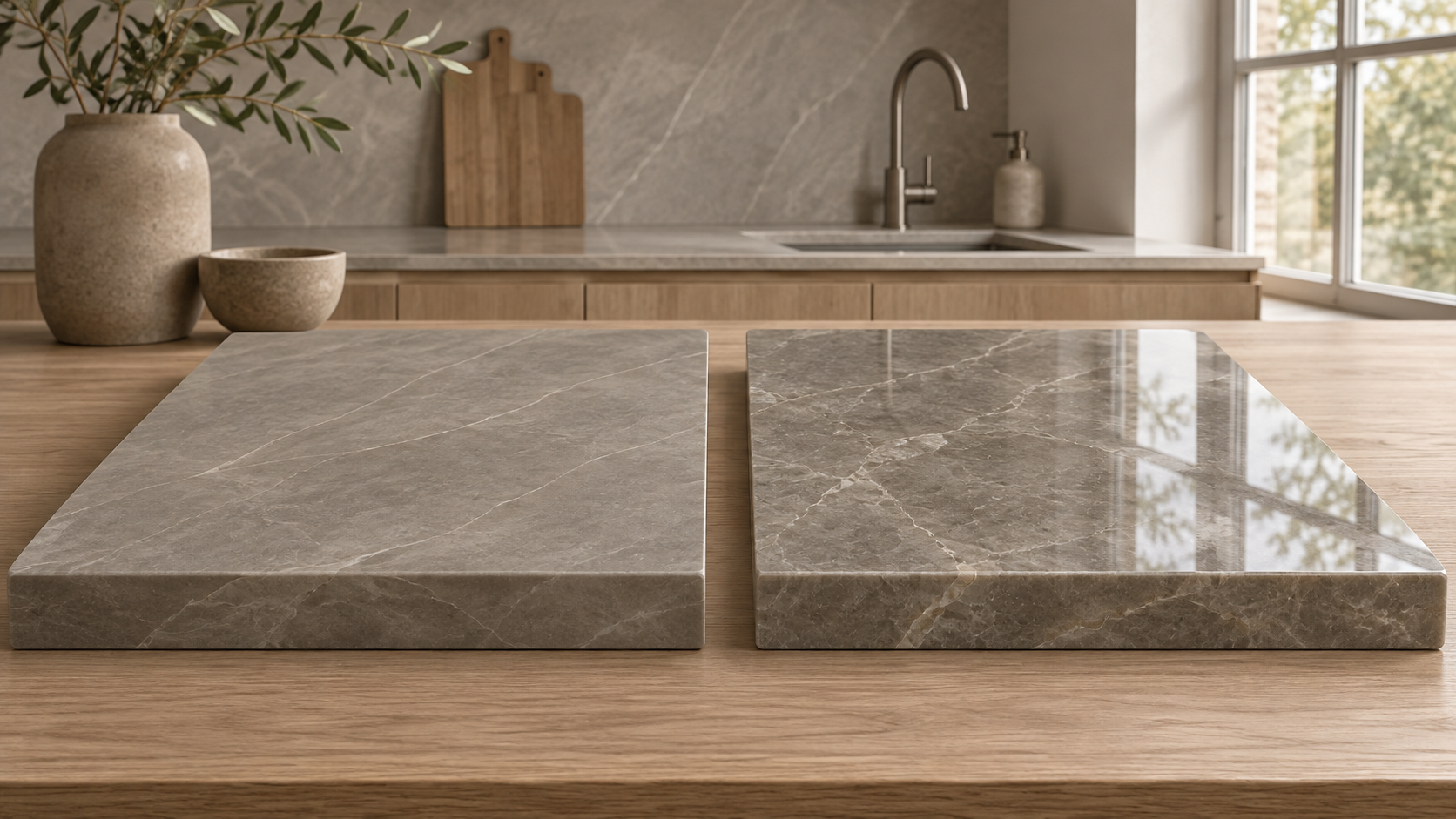
A countertop sample held upright in a showroom rarely tells you how the stone will look in your kitchen. Set the same sample flat beside a window and it may pick up a bright reflection. Move it beneath a cabinet light and the pattern may become more distinct or recede into the background. The difference is especially noticeable when you compare a honed finish with a polished one on the same stone.
What changes when the stone is honed or polished?
A honed finish is smooth, with a matte to satin appearance and relatively little reflection. A polished finish has a more reflective surface and can make the colour and pattern appear more pronounced. On a stone with subtle markings, polishing may bring out details that are easy to miss on the honed sample. On a slab with strong veining, a honed finish can give the pattern a softer appearance. naturalstoneinstitute.org
Consider how the finish sits alongside the materials you have already chosen. In a kitchen with matte oak fronts and limewashed walls, honed stone can carry that softness across the work surface. A polished countertop can introduce a measured amount of gloss in the same room. The choice often depends on how much attention you want the stone to draw when you enter.
Test the finish where the light will fall
Ask for honed and polished samples of the same stone, ideally with similar colouring and veining. Place them flat at approximately countertop height with a cabinet door sample beside them. Look at them in daylight and again with the lights you expect to use when cooking. If the kitchen is still being built, use the lighting plan to work out where fixtures will sit relative to the stone.
At the island, look from both the preparation side and the seating side. A pendant reflection can sit directly in your line of sight at the table while barely registering when you stand at the counter. Along a wall, switch on the lights beneath the cabinets and check the area where you will do most of your prep. Look for the finish that gives you the view you want from both places.
Look at how everyday marks will show
If you are considering marble, ask to see a sample that already shows signs of use. Acidic ingredients such as lemon juice can etch marble, leaving a dull mark. On polished marble, that change in sheen may be particularly apparent when light falls across it. Honed marble can still etch, so look at a used sample under angled light before deciding how comfortable you are with the way it will age. naturalstoneinstitute.org
For any stone you are considering, ask the supplier for care guidance for the specific material and finish. If a spare sample is available for handling, look at it after touching it and wiping it as you would during ordinary use. The visibility of fingerprints and wipe marks is worth judging on your chosen colour and finish, especially if you are drawn to a dark, evenly patterned stone.
Make the final choice on a larger surface
Once you prefer one finish, ask to see a larger piece or a full slab in that finish. A small sample can help you assess sheen, but it may show only one part of the pattern. Step back to a distance similar to the view from your dining area, then look again from close up. If the stone will continue up the wall as a backsplash, review it upright as well. Light strikes a vertical surface differently from a horizontal one, so the two can look distinct even in the same finish. architecture.tt
Choose the finish after seeing how it looks during the hours you use the kitchen most. A polished stone may have just the depth you want in soft daylight. A honed surface may feel more comfortable beneath the lights you switch on every evening. If you are comparing natural stone with Stonedinavia, bring a cabinet sample and a photo of the kitchen’s main light source to help you assess how the finishes will work together.